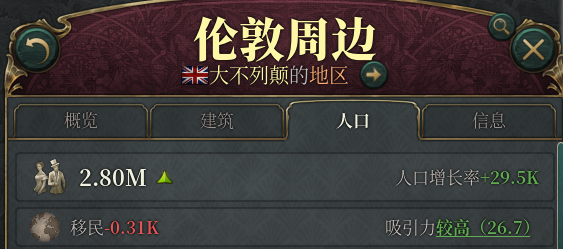
移民是指人群在地区之间的流动。
移民种类
维多利亚3中有两种移民。
- 市场内移民是两个在同一市场的地区之间的人群的流动。人权法律决定了谁可以在市场里移民,自由人(无移民控制)、非受歧视人群(移民控制)或者不可移民(关闭边境)。根据两个省份的当地基础设施和市场接入度等因素,每周能够移民的人数不尽相同。
- 大规模移民是一种机制,它模拟了19世纪大量人口迁移到美国、巴西和澳大利亚等地的情况。当某一文化经历
 动乱时,大规模移民就会发生,这是出现大量
  radical激进人口的结果。
移民吸引力
哪种人群从某个地区迁入或迁出,取决于每个地区的移民吸引力(Migration attraction)。
移民吸引力主要取决于地区内人群的平均生活水平,并受到各种因素修正,如人口过剩/不足,失业/可用工作等。移民会从移民吸引力较低的地区流向较高的地区,差值越大迁移人口越多。
移民吸引力数值随以下因素变化:
| 因素 | 影响因子 |
|---|---|
| 每点平均生活水平 | +2 |
| 每10k就业机会 最大200k |
+1.5 最大 +30 |
每10k自给建筑岗位 以75%最高岗位数量计算 最大600k |
+0.5 最大 +30 |
| 每10k失业人口 最大500k |
−1 最大 −50 |
| 地区没有人群 | +100 |
此外,很多地区特质和其他修正也会影响移民吸引力,一般为上表各数值之和的乘数。例如,青草运动法令可以通过花费  authority权威力为该地额外 +50%移民吸引力。
对于市场内移民,若当前地区某个人群在当地受歧视,且在目标地区接纳度更高,则移民吸引力会针对该人群 +50%;此外,若目标地区是对应文化的文化本土,移民吸引力会额外 +20%。
移民法律
国家的移民制度法律决定了人群允许从何处移民去往何地。其决定因素为地区的接纳度:
| 法律 | 有效移民身份 |
|---|---|
 无移民控制 无移民控制 |
任意接纳度 |
 移民控制 移民控制 |
至少60接纳度 |
 关闭边境 关闭边境 |
无 |
| 法律 |  自给农移民 自给农移民
|
|---|---|
 农奴制 农奴制 |
无 |
 佃农 佃农 |
仅限大规模移民 |
| 其他法律 | 任意移民 |
若人群向不同国家移民,则需要同时考虑出境国和入境国的移民法律。宗教歧视不会直接影响地区的移民吸引力,但可能影响人群是否将其选为目标地区。
市场内移民
 |
请帮助验证或更新此部分。 它最后被验证的 版本是 1.9。 |
游戏中绝大多数移民行为是市场内移民(Intra-market Migration),即人群在同一市场的不同地区间迁移。要使人口在市场内移民,必须满足几个阈值。其影响因素包括目标地区中存在的文化社区、人群的“移民倾向”,以及来源地区和目标地区中的文化歧视程度和移民法律。
移民倾向
| 地位 | 接纳度 | 移民倾向 |
|---|---|---|
 Violent Hostility暴力对抗 Violent Hostility暴力对抗 |
0-19 | 100 |
 Cultural Erasure文化抹除 Cultural Erasure文化抹除 |
20-39 | 100 |
 Open Prejudice公开歧视 Open Prejudice公开歧视 |
40-59 | 50 |
 Second-class Citizen二等公民 Second-class Citizen二等公民 |
60-79 | 20 |
 Full Acceptance完全接纳 Full Acceptance完全接纳 |
80-100 | 0 |
人群的移民倾向(Migration Desire)决定了人群移民的可能性有多大。该因素随人群的工作满意度升高而降低,随歧视的严重程度增长。因此,满意度较高的人群不太愿意移民,但接纳度较低的人群更有可能选择移民到接纳度更高的地区。
文化社群
In order for a pop to migrate within a market, the target state must have a matching cultural community. Cultural communities are present in each state that contains one or more pops of that culture. Additionally, each month, a new cultural community can appear in any state as long as that culture is present in the market. If a state has no pops of a given culture, that cultural community disappears after three weeks.[1]
The chance for a new cultural community to appear in a state has the following factors. This chance is calculated individually for each culture present in the market. If a state has 50 or more devastation, 60 or more turmoil, or is isolated, it cannot gain a new cultural community. The maximum chance is 4% for each culture for each state.
| 状态 | 参数 |
|---|---|
| 基础 | 0.1% |
地区拥有  港口 建筑 港口 建筑 |
+0.1% |
地区拥有  贸易中心 建筑 贸易中心 建筑 |
+0.1% |
| 地区沿海 | +0.1% |
地区拥有至少 20 未使用的  arable land arable land |
+0.1% |
地区拥有 "river river " 特质 不含安加拉河、顿河、额尔齐斯河、卡普阿斯河、密苏里河、萨拉瓦克河、圣劳伦斯河及叶尼塞河 |
+0.1% |
地区启用  Greener Grass Campaign Greener Grass Campaign Cost: 100Greener Grass Campaign Cost: 100Greener Grass CampaignPromote the state as a desirable place to migrate toRequires:  RomanticismState is not isolatedModifiers:+20 Migration attraction RomanticismState is not isolatedModifiers:+20 Migration attraction+25% Migration attraction 法令 |
+0.5% |
地区是  colony colony |
+0.5% |
| 状态 | 参数 |
地区是  首都地区 首都地区 |
×1.1 |
| 文化是主流文化 | ×2.5 |
拥有以下地区特质之一:
|
×1.2 |
地区拥有  Violent Suppression Violent Suppression Cost: 100Violent Suppression Cost: 100Violent SuppressionUse the nation's national guard to control the angry mobsRequires:  Standing ArmyOwner does not have the law Standing ArmyOwner does not have the law  Guaranteed Liberties Turmoil in state is at least 25%Modifiers: −50% State penalties from turmoil +2% Mortality per turmoil 法令 Guaranteed Liberties Turmoil in state is at least 25%Modifiers: −50% State penalties from turmoil +2% Mortality per turmoil 法令 |
×0.5 |
地区  devastation 至少为 20 devastation 至少为 20 |
×0.5 |
| 地区 turmoil 至少为 30 |
×0.5 |
地区  失业率高于 10% 失业率高于 10% |
×0.5 |
| 国家处于战争中 | ×0.5 |
| 地区可能会参与革命或分裂 | ×0.5 |
| 地区拥有 File:Goods 商品短缺.png 商品短缺 | ×0.8 |
| ×(市场接入度以小数计算) | |
| 地区是 File:State status slave state.png slave state 文化不与任何主流文化共享特质 |
×0.1 |
地区拥有  Malaria Malaria 国家尚未研究  Quinine Quinine |
×0.5 |
| 地区拥有 Severe Malaria Severe Malaria 国家尚未研究  Malaria Prevention Malaria Prevention |
×0.3 |
| 文化在该国拥有 Violent Hostility 地位 |
×0.1 |
| 文化在该国拥有 Cultural Erasure 地位 |
×0.3 |
| 文化在该国拥有 Open Prejudice 地位 |
×0.5 |
| 文化在该国拥有 Second-Class Citizen 地位 |
×0.7 |
| 地区拥有至少 5 个文化社区 | ×0.5 |
| 地区拥有至少 10 个文化社区 | ×0.3 |
| 地区拥有至少 15 个文化社区 | ×0.1 |


When a new cultural community first appears, it adds a −30 local acceptance penalty to its culture. This penalty decays each month by +0.25.
Target and size
In order for a state to be selected for immigration, it must have at least 25% higher migration attraction than the average in the entire market. Similarly, for a state to be selected for emigration, it must have at least 25% lower migration attraction than the average in the entire market. Finally, all eligible states with at least 75% of the migration attraction of the most attractive state receive some immigration. Pops do not migrate if their current state and target state are within 5 points of migration attraction.
Once it is determined that one or more pops will migrate, the number of individuals that migrate is 5 times the difference in migration attraction plus 1 more per point per 100K population in a state. For any given pop, at least 5% of that pop must migrate or no part of the pop does.
Each week a state that experiences migration can have no more than [math]\displaystyle{ 500 + (5 * \text{Infrastructure}) }[/math] individuals migrate in or out of the state. Additionally, no more than 0.5% of a state's population can emigrate per week. These limits are scaled down in states with less than 100K population to zero emigration below 20K population. Finally, 5% of the unemployment size of a state is added to its max emigration and removed its max immigration.
Depending on relative migration attraction between states in a country, the same state may receive immigrants and send out emigrants in the same week.
Power blocs
Intra-market migration can occur within power blocs that are  30pxs or have the principle
 Market Unification III or
  Freedom of Movement III.
The Freedom of Movement principle also increases the amount of migration by +25% (from tier 1) and the attraction for mass migration by +50% (from tier 2).
Mass migration
|
|
请帮助验证或更新此部分。 它最后被验证的 版本是 1.8。 |
A Mass Migration occurs when a culture is radical enough for pops to leave their homeland. Unlike intra-market migration, mass migrations are always between different countries and they often occur between markets, though they can occur within a market as well. Assuming Migration laws do not prevent their movement, pops of that culture migrate over a period of 12 months and the same culture cannot mass migrate from the same country again for another 48 months. A country is eligible to become the source of a mass migration if it has:
- at least 15% turmoil in a culture whose homelands its owns
- at least 100,000 potential emigrants
Pops that do not have a cultural homeland (such as Ashkenazi) can never mass migrate.
The chance of a mass migration starting each week for each combination of eligible culture and country is 2% times the cultural turmoil plus another 0.2% per point of average standard of living for the culture below 10 and finally plus another 1% per point of average SoL for the culture below 5. For example, a culture with 30% turmoil has a 60% chance of starting a mass migration, if the average standard of living for that culture is 4, that rises to 62.2%.
移民目的地
Once a country meets the origin requirements, the mass migration searches for an eligible  migration target移民目的地。 A state is eligible if:
- it is incorporated
- its owner has 30% or less turmoil in the migrating culture
- it has 20 or more arable land
- it has at least 70% market access
Each country has an attraction score which equals the average migration attraction of all its eligible states. Countries with fewer than 4 eligible states receive a penalty of 20% for each fewer state, up to 60% penalty for a country with only one eligible state. A country is semi-randomly chosen, with higher attraction scores more likely to be chosen, then a semi-random eligible state within that country is chosen as the migration target.
The culture affected by mass migration must also have at least 30 acceptance in the target country under its Citizenship laws. The culture also seeks to increase its acceptance by at least 10 from its current country, but may mass migrate for less if attraction is high enough. Increased acceptance in the target can result in up to five times as much migration, depending on the ratio of acceptance between origin and target.
Pops that mass migrate arrive either in the migration target or its neighboring states. With each neighboring state receiving approximately half as many individuals as the main target, scaled by the various factors.
奴隶
即使没有移民控制,  Slaves奴隶也被永久禁止移民行为。但拥有
  奴隶贸易法律的国家即使关闭边境也可以'进口'奴隶。引进的奴隶可以填充任意蓄奴地区中可使用奴隶的工作场所。
参见
- ↑
CULTURAL_COMMUNITY_LINGER_TIME_WEEKSin Victoria 3\game\common/defines/00_defines.txt